A Calm Visual Check of a Solar Array
A solar array visual check helps you notice visible changes safely, record what you see, and give a qualified professional useful details without climbing.
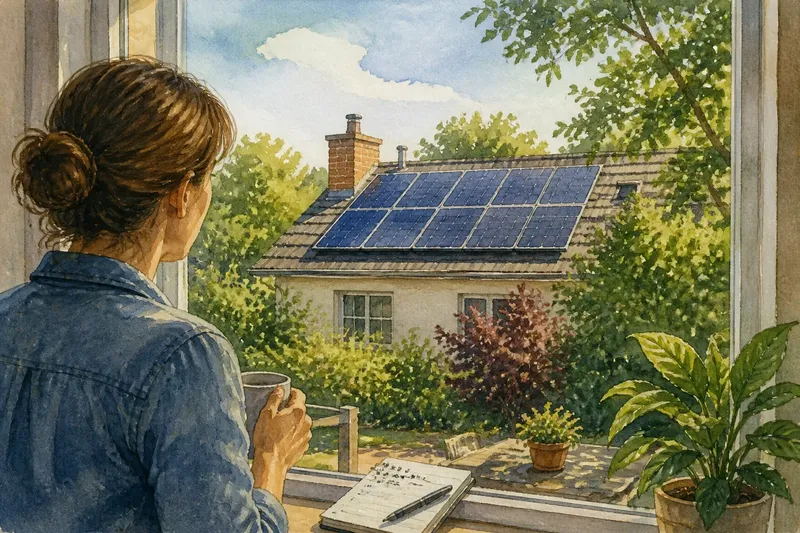
The most common mistake during a solar array visual check is climbing closer for a better look; the cost can be a fall, roof damage, or contact with electrical equipment. Stay on the ground or use a vantage point you already reach safely, such as an upstairs window. Your aim is to notice changes and record questions, not diagnose or repair the system.
Where can you observe the panels safely?
Choose a vantage point you can reach without climbing onto the roof, leaning out of a window, or using a ladder for this task. A driveway, patio, or safely accessible window may show part of the array; trees, roof angles, and neighboring buildings can limit the view. An incomplete view is still useful if you note what you could and could not see.
If you cannot see the panels clearly from a safe place, skip the visual check rather than improvising a higher perch. Do not use binoculars from an exposed edge or send someone onto the roof to get a closer look. A qualified solar professional can assess areas hidden from your normal vantage points.
- Clear ground-level view: If you can see some or all of the array from a stable spot without reaching or climbing, observe from there; if not, use a safe indoor vantage point or record that the view is limited.
- View through a window: If you can look from inside without leaning out, use that view; if opening the window would require leaning, keep it closed and choose another safe spot.
- Limited or blocked view: If trees, buildings, or roof angles hide part of the array, note which area you cannot see; if you have a specific concern about that area, ask a qualified professional to assess it.
Use only vantage points that are safe in ordinary household use.
What should you look for without touching anything?
Look for changes you can describe in plain language: a panel that appears displaced compared with its neighbors, a new-looking crack or dark mark, loose material visible near the array, or debris that seems to cover part of a panel. Note the location as best you can, such as “upper row near the chimney,” rather than guessing at a technical cause.
Also notice the roof area and surroundings. A branch resting near the array, a new stain visible below the roof edge, or a change in how the system sounds from its usual location may be worth mentioning. Do not touch panels, wiring, mounting hardware, or anything hanging from the roof.
Reflections, dirt, shadows, and normal surface variation can look unusual from a distance. Record what you see, not what you think it means. If the monitoring display or inverter shows an alert, write down its exact wording rather than opening equipment or resetting anything.
Which routine fits your situation?
Different homes call for different levels of observation. Choose the least involved routine that gives you a safe, useful record.
- You have a clear ground-level view: If the array is visible from a path or yard, make a brief note while you are already outside; if seeing it would require climbing or reaching, skip the view and record the limitation.
- You can see the array only from indoors: If a familiar room or closed-window view is safe, use that same vantage point; if it requires leaning out, choose another spot or note that the view is unavailable.
- Trees, buildings, or roof geometry block the view: If part of the array is hidden, record the blind spot and rely on system alerts or professional service for information you cannot see; if a specific concern involves the hidden area, contact a qualified professional.
- You notice possible damage or a loose object: If anything appears unstable, keep clear of the roof and the area below it and contact a qualified solar professional; if no visible concern remains, continue observing only from a safe spot.
- You see smoke, sparks, or another immediate hazard: If there is an immediate hazard, move away and contact local emergency services; do not approach the equipment or try to shut it down yourself.
Choose observation, professional follow-up, or emergency help according to what is visible—not according to how close you can get.
How can you make a useful record?
A short note can help a professional understand what prompted your call. Include the date in ordinary terms, your vantage point, the part of the array you could see, and a neutral description of any change. If you take a photo, do so from a safe place and avoid moving toward an edge to frame it.
Say you can see the lower row from your patio and notice a small object resting near one panel. Note the row, the patio vantage point, and that the object appears to be present; do not climb up to identify or remove it. The result is a clear, limited description a professional can use to decide what questions to ask next.
Keep observations separate from assumptions. “A dark patch appeared near the left edge” is more useful than “the panel is failing,” because the first reports what you saw and leaves diagnosis to someone qualified.
When should you call a professional, and what should you ask?
Contact a qualified solar professional if you notice a visible crack, a panel that appears out of position, damaged-looking material, a recurring system alert, or a change you cannot confidently describe. If you see an immediate hazard such as smoke or sparks, step away and call local emergency services instead of waiting for a routine service appointment.
Keep the conversation practical: “Can you assess the area I described?” “Should I avoid any part of the property while you review it?” “Is there a system alert I should report exactly as displayed?” Use a qualified professional for roof access, equipment handling, and repairs.
What questions come up during a solar array visual check?
How often should I look at my solar panels?
There is no single schedule that fits every home. A quick look when you are already in a safe viewing spot can help you notice changes without making roof access part of the routine.
Can I clean a panel if it looks dirty?
Do not climb onto the roof or touch the array to clean it. Check your system documentation or ask the installer or a qualified solar professional whether cleaning is appropriate for your equipment and circumstances.
What if I cannot see the entire array?
Record which area is hidden and use the part you can safely observe. Ask a qualified professional to assess the unseen section if you have a specific concern or system alert.
Should I take a photo of a possible problem?
A photo can help show where a visible change appears if you can take it from a safe, ordinary vantage point. Do not move closer, climb, or lean out to improve the image.
A calm solar array visual check stays within safe limits: notice visible changes, describe them without diagnosing, and pass unresolved questions to a qualified professional. If you cannot see an area safely, record that limit; it gives the professional useful context without putting you at risk.