How a Solar Cell Turns Sunlight Into Current
Learn how a solar cell turns sunlight into current, how semiconductor layers direct charge, and why panels need a separate battery to store energy.
The most common solar-cell misconception is that a panel stores sunlight for later. That confusion can make household solar seem mysterious, but it has a simple cost: it blurs the difference between making electricity and storing it. A solar cell turns light into electrical output as light reaches it; a separate battery, if the system has one, stores energy for later.
What does sunlight do inside a solar cell?
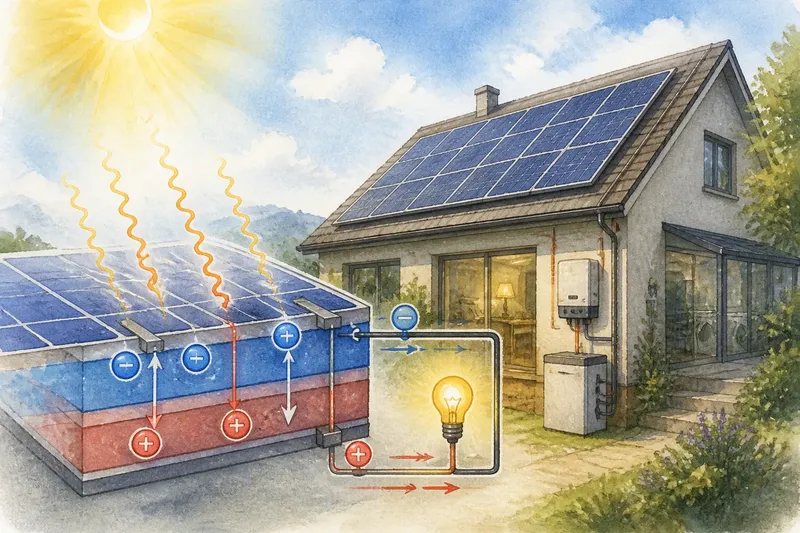
Sunlight arrives in packets of energy called photons. When a photon reaches the semiconductor material in a cell, it may transfer energy to an electron. If the electron gains enough energy, it can break free from its usual place in the material and move more readily.
This creates a mobile electron and an opening where it used to be, called a hole. The hole is not a tiny particle moving through the cell. Instead, neighboring electrons can shift into the opening, making the hole appear to move in the opposite direction.
Not every photon creates useful moving charge. Some light reflects off the cell or passes through it, while some of its energy becomes heat. The cell’s material and design affect which incoming light can contribute to electrical output.
How do semiconductor layers direct charge?
Freed electrons and holes would not provide a steady current if they simply wandered around and recombined. A solar cell uses differently treated regions of semiconductor material to encourage the two kinds of charge to separate.
In simplified terms, one region has extra mobile electrons, while another has openings that can accept electrons. Where the regions meet, charge redistributes and creates an internal electric field.
The field helps guide electrons toward one side of the cell and holes toward the other. Electrical contacts collect charge from those regions, allowing electrons to leave through one terminal, travel through an external circuit, and return at the other.
The field is a sorting influence, not a pump that stores or manufactures charge. Light supplies the energy that frees carriers; the cell’s structure helps separate and route them.
When does separated charge become current?
A voltage can develop between a cell’s terminals when light creates separated charge. Current flows when the terminals connect through a conducting path, such as a circuit powering a device. Electrons move through the external path as the cell’s internal processes allow charge to circulate.
Imagine a small solar cell connected to a classroom motor. In this invented situation, light reaches the cell and frees some electrons; the cell’s internal field separates the charges. With the motor connected, electrons travel through the circuit and the motor may turn. If a hand shades the cell, less light-driven charge is available, so the motor may slow or stop.
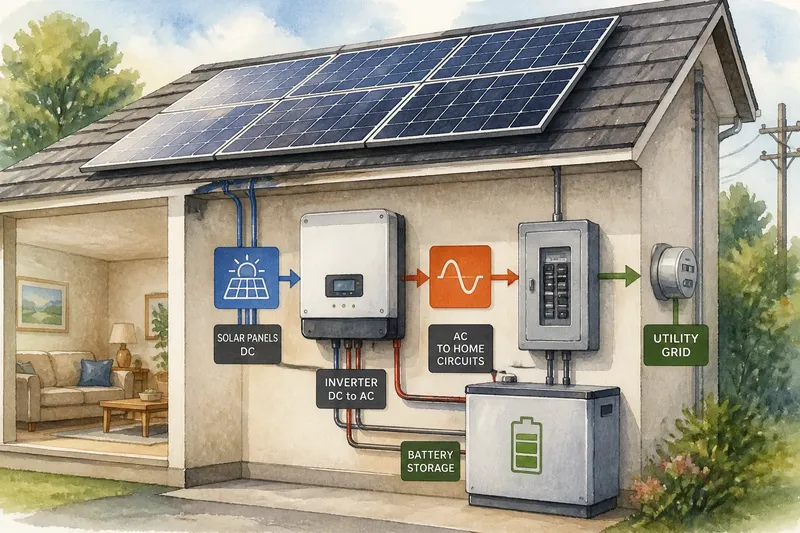
This explains why a panel is not a battery. A battery can provide stored energy after its charging source is gone. A solar cell’s output depends on light reaching it; a separate battery, if included in a home system, stores energy through a different process.
Why do manufacturers connect cells into panels?
A single cell produces a modest electrical output, so manufacturers connect many cells to form a module, commonly called a panel. Conductive ribbons link the cells into a circuit, and glass and encapsulating materials protect the working parts from the elements.
The cells’ electrical outputs combine according to how they are wired. The module’s terminals provide direct-current output for the rest of the solar system, while the number and arrangement of cells vary with the module design.
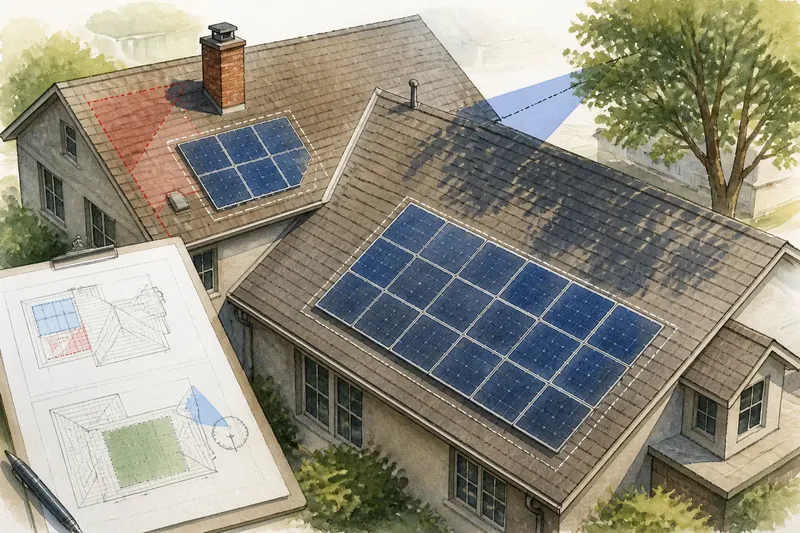
Conditions affecting one part of a connected group can influence its electrical path. Shade across some cells, for instance, can change how current moves through a string. Bypass components in many modules provide alternate paths around affected cell groups; they do not store energy.
What happens to light that does not become electricity?
Conversion is not a perfect handoff from light to electrical output. A photon may have too little energy to free an electron, or excess energy may become heat rather than additional electrical energy. Reflection and recombination—when an electron falls back into an available hole—also reduce the charge that reaches the circuit.
Heat matters because semiconductor behavior changes with temperature. A cell receiving strong sunlight can warm up, shifting its electrical characteristics. Brightness alone, then, does not describe every factor affecting a panel’s output.
These losses do not mean the cell has stopped working. They are part of the physical process: the cell converts some incoming light energy into electrical energy, while other portions are reflected, transmitted, or dissipated.
How does a solar cell turn sunlight into current?
Does a solar cell store sunlight?
No. A cell converts light energy into electrical output while light is available; it does not keep sunlight for later use. A home battery, when present, stores energy through a separate process.
What is the difference between an electron and a hole?
An electron is a negatively charged particle that can move through the semiconductor and an external circuit. A hole is an electron’s vacancy in the material; neighboring electrons shifting into vacancies make that opening appear to travel.
Why does a solar cell need an electric field?
The field helps direct freed electrons and holes toward opposite sides of the cell. Without effective separation, many would recombine before their movement could contribute to current through an external circuit.
Can a solar cell produce current in shade?
Some light can still reach a shaded cell, so it may continue producing electrical output, though less light generally means fewer photons are available to free charge carriers. The result depends on the type and amount of shade, cell design, and how cells are connected.
What should homeowners remember about solar cells?
Keep the roles distinct when considering solar equipment: cells convert light into electrical output, modules connect cells, and any storage device is a separate part of the system. This makes it easier to understand why panel output changes with available light and why nighttime power requires another source, such as stored energy or the electric grid.
To follow the process, trace the charge: a photon can free an electron, the semiconductor junction helps separate electron and hole, and a connected circuit gives charge a route to move. When you see a panel in sunlight, remember that it is converting energy, not holding sunlight for later.